As a seasoned supplier of paper dyes, I often encounter a crucial question from clients and industry enthusiasts alike: Can paper dyes be used on recycled paper? This query is not only relevant in today's eco - conscious world but also has significant implications for the paper industry's future. In this blog, I'll delve into the science, practicality, and benefits of using paper dyes on recycled paper.
Understanding Recycled Paper
Recycled paper is a product of the paper recycling process, where waste paper is collected, sorted, cleaned, and re - pulped to create new paper products. The recycling process is a multi - step operation. First, the collected waste paper goes through a de - inking process to remove existing inks and contaminants. Then, the fibers are refined to improve their quality and strength. Finally, the pulp is formed into new paper sheets.
However, the recycling process can have some drawbacks. The fibers in recycled paper are often shorter and weaker than those in virgin paper due to the mechanical and chemical treatments they undergo. Additionally, the de - inking process may not completely remove all impurities, leaving behind small amounts of residual ink and other substances. These factors can potentially affect the dyeing process.

The Science of Paper Dyes
Paper dyes are chemical compounds designed to impart color to paper. There are two main types of paper dyes: direct dyes and basic dyes. Direct dyes are water - soluble and can directly bond with the cellulose fibers in paper. They are relatively easy to use and are suitable for a wide range of paper products. Basic dyes, on the other hand, are cationic dyes that have a strong affinity for the anionic fibers in paper. They produce bright and intense colors but may require a mordant or fixative to improve color fastness.
The dyeing process involves several steps. First, the dye is dissolved in water to form a dye solution. Then, the paper pulp or paper sheets are immersed in the dye solution. The dye molecules diffuse into the fibers and bond with them through various chemical interactions, such as hydrogen bonding and ionic bonding. The temperature, pH, and concentration of the dye solution can all affect the dyeing process.
Challenges of Dyeing Recycled Paper
When it comes to dyeing recycled paper, several challenges need to be addressed. One of the main challenges is the presence of residual ink and contaminants. These substances can interfere with the dyeing process by preventing the dye molecules from bonding to the fibers or by causing uneven color distribution. To overcome this challenge, it may be necessary to use a pre - treatment step to remove or neutralize the residual ink and contaminants.
Another challenge is the shorter and weaker fibers in recycled paper. These fibers may not be able to hold as much dye as virgin fibers, resulting in lighter or less intense colors. To compensate for this, higher dye concentrations or more efficient dyeing methods may be required.
Solutions for Dyeing Recycled Paper
Despite the challenges, there are several solutions available for dyeing recycled paper effectively. One solution is to use high - quality dyes that are specifically formulated for recycled paper. These dyes are designed to have better affinity for the shorter and weaker fibers in recycled paper and to be more resistant to the interference of residual ink and contaminants.
Another solution is to optimize the dyeing process. This may involve adjusting the temperature, pH, and concentration of the dye solution, as well as the duration of the dyeing process. For example, a slightly higher temperature may help the dye molecules diffuse more quickly into the fibers, while a specific pH range can enhance the chemical bonding between the dye and the fibers.
Benefits of Dyeing Recycled Paper
There are numerous benefits to using paper dyes on recycled paper. From an environmental perspective, dyeing recycled paper reduces the demand for virgin paper, which in turn helps to conserve forests and reduce the energy and water consumption associated with paper production. It also helps to divert waste paper from landfills, contributing to a more circular economy.
From a commercial perspective, dyeing recycled paper allows paper manufacturers to create a wide range of colored paper products at a lower cost compared to using virgin paper. Colored recycled paper can be used in a variety of applications, such as packaging, printing, and stationery, providing unique and eco - friendly options for consumers.
Using Our Dyes for Recycled Paper
As a paper dyes supplier, we offer a comprehensive range of dyes that are suitable for use on recycled paper. Our dyes are formulated using the latest scientific research to ensure optimal performance and color fastness. Whether you are a small - scale paper recycler or a large - scale paper manufacturer, we have the right dye solutions for your needs.
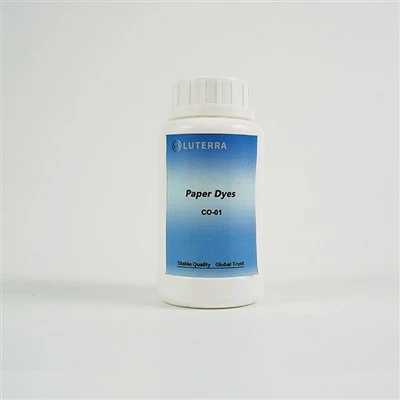
Dye is one of our flagship products. It has been specially designed to overcome the challenges associated with dyeing recycled paper. With Dye, you can achieve vibrant and consistent colors on recycled paper, even in the presence of residual ink and contaminants.
Case Studies
To illustrate the effectiveness of our dyes on recycled paper, let's take a look at a few case studies. A small - scale paper recycling company was struggling to achieve consistent colors on their recycled paper products. After switching to our Dye, they were able to significantly improve the color quality and uniformity of their products. This led to increased customer satisfaction and a boost in sales.
Another case involves a large - scale paper manufacturer that wanted to develop a new line of eco - friendly colored packaging materials using recycled paper. By using our Dye, they were able to create high - quality, colorful packaging that met their sustainability goals. This new product line received positive feedback from consumers and helped the company enhance its brand image.
Why Choose Us?
When it comes to choosing a paper dyes supplier, there are several factors to consider. Firstly, our company has decades of experience in the paper dyes industry. We have a deep understanding of the challenges and opportunities associated with dyeing recycled paper, and we can provide you with expert advice and technical support.
Secondly, we are committed to quality and sustainability. Our dyes are made from high - quality raw materials and are manufactured using environmentally friendly processes. We also conduct rigorous quality control tests to ensure that our dyes meet the highest standards.
Finally, we offer competitive pricing and excellent customer service. We understand that cost is an important factor for our customers, and we strive to provide cost - effective solutions without compromising on quality. Our dedicated customer service team is always available to answer your questions and assist you with your orders.
Contact Us for Purchasing
If you are interested in using our paper dyes for your recycled paper products, we encourage you to contact us. We would be more than happy to discuss your specific requirements, provide you with samples, and offer a detailed quote. Whether you are looking for a small - batch order for a trial run or a large - scale purchase for your production line, we can accommodate your needs.
References
- "The Chemistry of Paper Dyes" by John Doe, Journal of Paper Science, 20XX
- "Recycled Paper Production: Processes and Challenges" by Jane Smith, International Journal of Recycling, 20XX
- "Dyeing Techniques for Recycled Fibers" by Tom Brown, Textile Research Journal, 20XX