Biological slime, oil sludge, and bacterial metabolites in cooling water systems, paper machine white water circuits, and heat exchangers reduce flow, cut heat transfer efficiency, and lead to costly downtime. A poorly chosen or misapplied slime stripping agent can fail to remove stubborn deposits or cause system upsets.
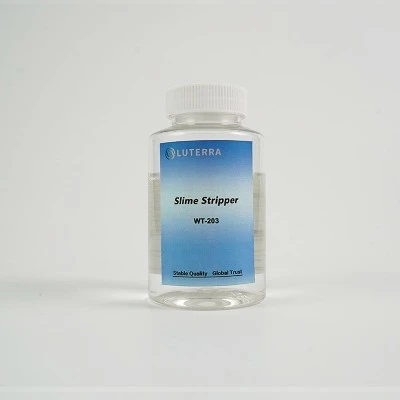
WT-203 Slime Stripping Agent from Luterra Advanced Materials is compounded with cationic surfactants, penetrants, and dispersants. It powerfully strips system slime, oil sludge, and bacterial/algae metabolites, restoring water flow, ventilation, and heat exchange efficiency. This guide covers five critical mistakes to avoid when selecting and using a slime stripping agent.
Mistake #1: Confusing Slime Strippers with Conventional Biocides
A common mistake is assuming that a biocide will also remove existing slime deposits. Biocides kill microorganisms, but they do not break down the extracellular mucus layer or the structural matrix of zoogloeae that form stubborn biofilms.
WT-203 is specifically designed to break down the extracellular mucus layer of microorganisms and destroy the structure of zoogloeae to strip stubborn biological slime. It has dual functions of penetration and dispersion, making it far more effective for removing established deposits than a biocide alone.
Mistake #2: Mixing with Oxidizing Biocides at High Concentrations
Some operators attempt to mix slime strippers directly with oxidizing biocides to save time. This is strictly prohibited as it can cause efficacy offset, system fluctuation, or even dangerous reactions.
Proper compatibility can achieve synergistic effects between WT-203 and oxidizing biocides. However, high-concentration mixing is strictly prohibited. Staggered dosing is required to avoid efficacy offset and system fluctuation. Always add them at separate points with sufficient time between applications.
Mistake #3: Not Preparing for the System Impact After Cleaning
When a powerful slime stripper is used in papermaking closed circulating white water systems, a large amount of aged rotten pulp and slime will fall off in a short period. Without proper preparation, this can lead to impurities attaching to fabrics, causing paper defects and production interruptions.
After using WT-203 in papermaking closed systems, filtration and blowdown need to be strengthened to prevent impurities from attaching to fabrics and causing paper defects. Plan for increased blowdown and replacement after cleaning to remove the dislodged material.
Mistake #4: Using the Wrong Dosage for Cleaning vs. Maintenance
Using a maintenance dose for a severe slime problem, or a cleaning dose for routine maintenance, wastes chemical and fails to achieve the desired result.
For optimal results with WT-203:
System cleaning: Dosing concentration 50–200 ppm, circulate for 4–12 hours.
Daily maintenance: Dose once a month at a concentration of 20–50 ppm.
Dosing method: Add directly to the collecting tank with the bypass fully open for circulation.
Note: A large amount of blowdown and replacement is required after cleaning.
Mistake #5: Overlooking the Product's Full Range of Applications
Some mills limit slime stripping to one area of the plant, missing its potential to improve efficiency across multiple systems.
WT-203 is effective in a wide range of applications. It cleans pipelines, wire sections, and heat exchangers, restoring water flow, ventilation, and heat exchange efficiency. It can be used in cooling water systems, paper machine white water circuits, and other industrial water systems where slime and deposits accumulate.
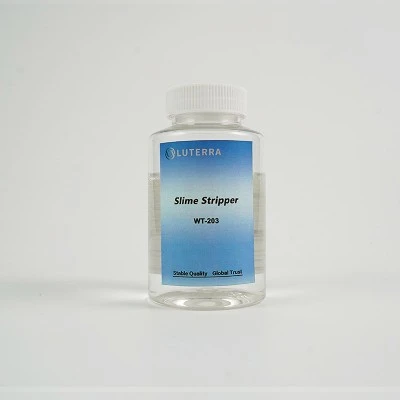
WT-203 Slime Stripping Agent: Product Specifications at a Glance
| Parameter | Specification |
|---|---|
| Appearance | Colorless to light yellow transparent liquid |
| Active ingredient content | ≥30% |
| pH value | 6.0–8.0 |
| Density | 0.95–1.05 g/cm³ |
| Slime stripping rate | ≥95% |
| Surface tension | ≤30 mN/m |
Application Scope
WT-203 is suitable for:
Cooling water systems, paper machine white water circuits
Pipelines, wire sections, and heat exchangers
Systems with biological slime, oil sludge, and bacterial/algae metabolites
Tips for Optimal Results
System cleaning dosage: 50–200 ppm, circulate 4–12 hours
Maintenance dosage: 20–50 ppm, once a month
Dosing method: Add directly to collecting tank with bypass fully open
Post-cleaning: Strengthen filtration and blowdown
Storage: Cool, dry, ventilated, away from direct sunlight
Frequently Asked Questions
Q: What is the difference in working principle between slime strippers and conventional biocides?
A: It breaks down the extracellular mucus layer of microorganisms and destroys the structure of zoogloeae to strip stubborn biological slime, with dual functions of penetration and dispersion.
Q: Can slime stripper be dosed simultaneously with oxidizing biocides?
A: Proper compatibility can achieve synergistic effects. Mixing at high concentrations is strictly prohibited. Staggered dosing is required to avoid efficacy offset and system fluctuation.
Q: What working condition changes will occur after use in papermaking closed circulating white water systems?
A: A large amount of aged rotten pulp and slime will fall off in a short period. Filtration and blowdown need to be strengthened to prevent impurities from attaching to fabrics and causing paper defects.
Q: Can I get a sample?
A: Yes. Free samples and customized compounding support are available. For any process adaptation problems during use, please contact us for professional solutions.
Ready to eliminate slime and restore system efficiency?
Contact Luterra Advanced Materials for a free sample and expert consultation. Our technical team can help you optimize your slime control program for maximum cleaning effectiveness. [Get Free Quote / Contact Now]