Microbial contamination in papermaking white water and circulating cooling systems leads to slime buildup, rotten pulp, paper breaks, and unpleasant odors. Choosing the wrong biocide-or using it incorrectly-can waste chemicals, damage equipment, and fail to control the problem.


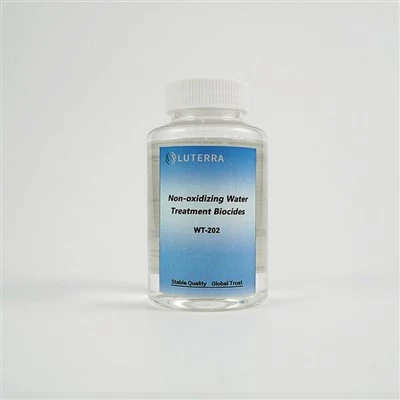
Luterra Advanced Materials offers two targeted solutions: WT-201 Oxidizing Biocide for rapid algae and slime control, and WT-202 Non-Oxidizing Biocide for long-term microbial inhibition. This guide covers five critical mistakes to avoid when selecting and using industrial water treatment biocides.
Mistake #1: Confusing Oxidizing and Non-Oxidizing Biocides
One of the most common and costly mistakes is treating these two biocide types as interchangeable. They work through fundamentally different mechanisms and serve different purposes.
Oxidizing biocides (like WT-201) destroy microbial cell walls and metabolic enzymes through strong oxidation. They act fast, have no drug resistance issues, and are ideal for rapid algae killing and slime control. However, they are easily consumed by reducing substances and anionic auxiliaries in the system.
Non-oxidizing biocides (like WT-202) provide broad-spectrum bacteriostasis through targeted biochemical interference. They are more stable, compatible with anionic chemicals, and suitable for daily maintenance and long-term microbial control.
Using an oxidizing biocide for daily maintenance can lead to equipment corrosion and chemical waste; using a non-oxidizing biocide for shock treatment may not achieve the rapid control needed during an outbreak.
Mistake #2: Ignoring Chemical Compatibility in Your System
Your wet end chemistry directly impacts biocide effectiveness. Adding a biocide that reacts negatively with other chemicals wastes money and can cause process upsets.
WT-201 (oxidizing) is easily consumed by reducing substances and anionic auxiliaries, which lowers its active content. To maintain efficacy, optimize the dosing position and consider segmented dosing.
WT-202 (non-oxidizing) offers excellent overall compatibility-it will not cause flocculation or failure reactions with anionic starch, sizing agents, or dispersants. This makes it a safer choice for complex chemical environments.
Mistake #3: Using a Single Biocide Type Indefinitely
Long-term use of a single biocide type, especially non-oxidizing, promotes microbial resistance. Over time, the same microorganisms adapt and the product becomes less effective.
To avoid this, it is recommended to use oxidizing and non-oxidizing biocides alternately or intermittently. This rotates the bacteriostatic mechanism and reduces the risk of microbial resistance. For example, use WT-201 for weekly shock treatments and WT-202 for daily maintenance between shocks.
Mistake #4: Overlooking Equipment and Fabric Impact
Biocides, particularly oxidizing types, can damage paper machine components if used improperly. High concentrations may slightly corrode carbon steel parts and age fabric fibers.
When using WT-201, maintain a reasonable concentration in daily operations. It is recommended to use it in combination with our slow-release agents and non-oxidizing biocides to mitigate potential corrosion risks.
WT-202 is non-corrosive and will not damage equipment or upset the charge balance of the wet end system, making it suitable for shock sterilization even under severe rotten pulp conditions.
Mistake #5: Dosing at the Wrong Place and Time
Even the right biocide fails if added incorrectly. Dosing point and timing affect how much active ingredient reaches the problem area before being consumed or washed away.
For WT-201 (Oxidizing):
Dosing point: Cooling tower inlet and collecting tank
Shock treatment: 1–5 ppm, once a week
Continuous dosing: Maintain residual chlorine at 0.1–0.3 ppm
Important: Avoid mixing with non-oxidizing biocides within 8 hours after dosing
For WT-202 (Non-Oxidizing):
Dosing point: Collecting tank, cooling tower, upstream of security filter
Continuous dosing: 0.5–3 ppm for routine maintenance
Shock treatment: 5–20 ppm, 1–2 times a week
Important: Avoid mixing with strong oxidants during application


Product Comparison at a Glance
| Parameter | WT-201 Oxidizing Biocide | WT-202 Non-Oxidizing Biocide |
|---|---|---|
| Appearance | Pale yellow to yellowish-green liquid | Light yellow to amber liquid |
| Active ingredient | ≥5% | ≥14% (Isothiazolinone) |
| pH value | 2.0–4.0 | 2.0–5.0 |
| Density (25℃) | 1.10–1.20 g/cm³ | 1.05–1.15 g/cm³ |
| Sterilization rate | ≥99.99% | ≥99.9% (24h) |
| Stability | ≥90% after 6 months | No stratification after 12 months |
| Mechanism | Oxidation | Biochemical interference |
| Resistance risk | Low | Higher (rotate with oxidizing) |
| Compatibility | Consumed by reducing substances | Compatible with anionic additives |
Tips for Optimal Biocide Program
Assess your problem: Rapid algae/slime outbreak → start with WT-201 shock; long-term prevention → use WT-202 daily.
Rotate types: Alternate oxidizing and non-oxidizing biocides to prevent resistance.
Optimize dosing point: Add where active ingredient reaches the problem area before being consumed.
Monitor residual levels: Especially for WT-201, maintain proper residual chlorine.
Follow separation rules: Do not mix WT-201 with non-oxidizing biocides within 8 hours of dosing.
Frequently Asked Questions
Q: What is the core functional difference between oxidizing and non-oxidizing biocides?
A: Oxidizing biocides (WT-201) destroy cells through strong oxidation-fast, no resistance, ideal for shock treatment. Non-oxidizing biocides (WT-202) provide stable, long-term microbial inhibition through biochemical interference, suitable for daily maintenance.
Q: Will a large amount of anionic chemicals in the wet end affect oxidizing biocide efficacy?
A: Yes. WT-201 is easily consumed by reducing substances and anionic auxiliaries. Optimize dosing position and use segmented dosing to maintain efficacy.
Q: Will long-term use of oxidizing biocide damage equipment?
A: High concentrations may slightly corrode carbon steel parts and age fabric fibers. Maintain reasonable concentrations and consider using with our slow-release agents and non-oxidizing biocides.
Q: Can non-oxidizing biocide be used for shock treatment under severe conditions?
A: Yes. WT-202 is applicable for shock sterilization, which can accurately strip biofilm without corroding equipment or damaging the wet end charge balance.
Ready to optimize your water treatment biocide program?
Contact Luterra Advanced Materials for a free sample and expert consultation. Our technical team can help you develop a tailored biocide rotation strategy for your specific system. [Get Free Quote / Contact Now]